
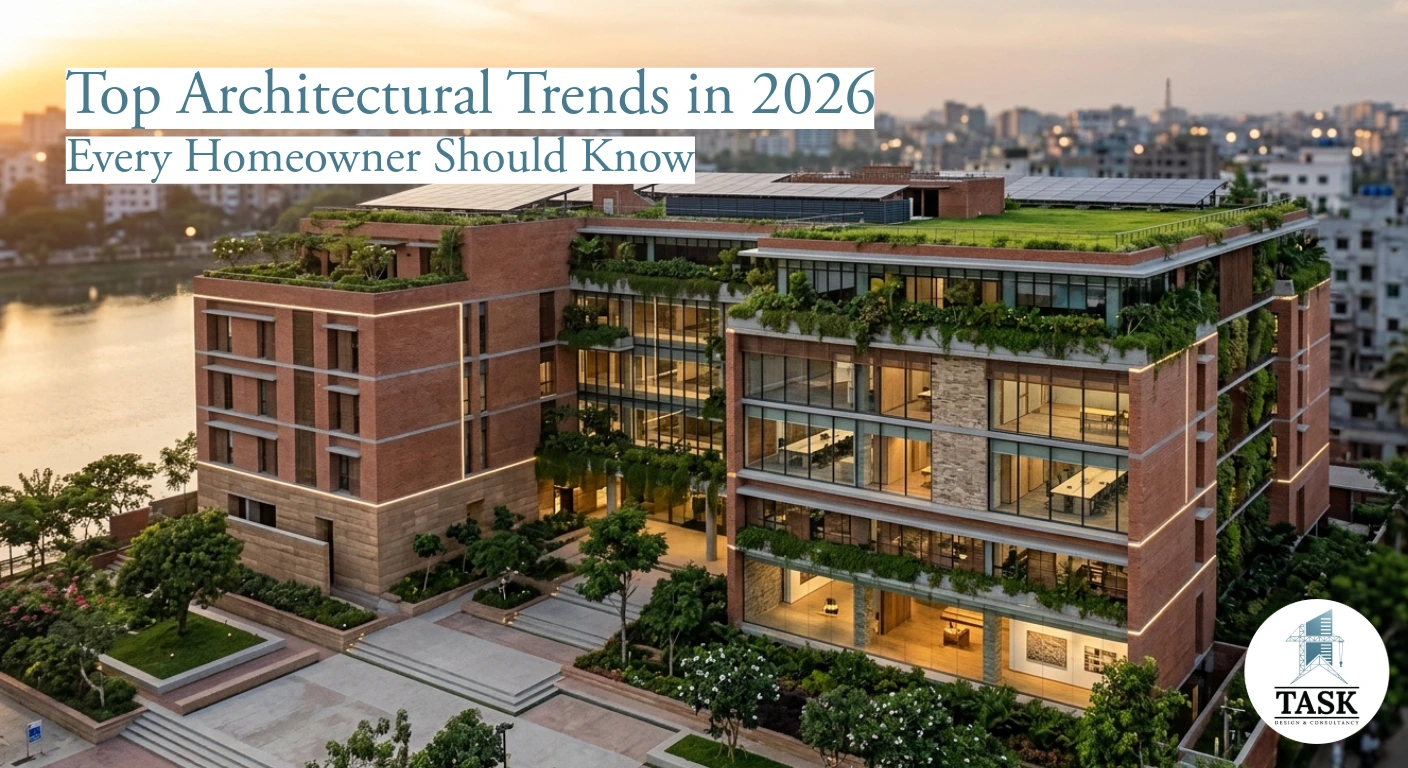
Top Architectural Trends in 2026 Every Homeowner Should Know
The architectural trends in 2026 are not predictions anymore
— they are happening right now, in buildings being designed and constructed across Dhaka and the rest of the world. Sustainability has stopped being optional. Artificial intelligence has entered the design process itself. And the way people want to live and work inside buildings has permanently shifted.
Whether you are planning a home, an office, or a commercial space, understanding where architecture is heading helps you make smarter decisions — and ask better questions when you sit down with a design team.
Here is a thorough look at the ten architectural trends in 2026 and what each one means for building in Dhaka specifically.
1. Sustainable and Regenerative Design
Among all the architectural trends in 2026, sustainability has made the biggest leap. It has moved from being a design preference to a professional and regulatory baseline. The newer conversation is no longer about reducing harm — it is about regenerative design, meaning buildings that actively restore the environment rather than simply consuming less of it.
What this looks like in practice:
- Renewable and recycled materials including bamboo, rammed earth, and recycled steel replacing conventional alternatives
- Energy-positive buildings that generate more power than they consume through solar and passive systems
- Green roofs, rainwater harvesting, and greywater recycling integrated into the core design
- Carbon-sequestering concrete and next-generation bioplastics entering mainstream construction
For clients in Bangladesh, this matters beyond environmental idealism. Buildings designed with energy efficiency built in from the start cost significantly less to operate — and in a city like Dhaka where electricity costs and urban heat are real daily concerns, that saving is concrete and measurable.
According to the World Green Building Council, green buildings can reduce energy use by up to 50% compared to conventional construction. That is not a marginal difference.
2. AI-Assisted and Responsive Architecture
Artificial intelligence has become one of the most transformative architectural trends in 2026 — not just in how buildings are managed but in how they are designed in the first place.
AI tools now allow design teams to generate and evaluate dozens of spatial configurations simultaneously, test structural and energy performance virtually before construction begins, and identify potential problems that would previously only surface during the build. The result is fewer expensive revisions, more optimized layouts, and faster delivery.
Inside completed buildings, AI continues to work:
- Smart HVAC systems that adapt in real time to occupancy levels and outdoor weather
- Predictive maintenance systems that flag structural and mechanical issues early
- Automated lighting that adjusts based on natural light levels and usage patterns
- Touchless access and environmental monitoring for air quality, humidity, and temperature
For commercial clients in Dhaka — offices, retail spaces, industrial facilities — these systems directly reduce operational costs and improve occupant experience of architectural trends in 2026. Firms that have not yet integrated AI into their workflow are already falling behind those that have.
3. Biophilic Design and Natural Integration
Biophilic design is one of the architectural trends in 2026 that has moved from luxury feature to near-standard expectation, particularly in residential and high-end commercial projects.
The principle is straightforward: humans function better when they have meaningful contact with natural elements. Plants, water, natural light, organic materials, and nature-inspired forms all produce measurable improvements in mental wellbeing, productivity, and physical health. The research behind this has accumulated to the point where it is difficult for serious designers to ignore.
This is one of the architectural trends in 2026 that has the most direct impact on daily comfort:
- Living green walls, indoor gardens, and planted terraces built into the structural design
- Natural ventilation systems that reduce mechanical air conditioning dependency
- Skylights, light wells, and open layouts that maximize natural daylight penetration
- Organic materials — wood, stone, clay, bamboo — used structurally and decoratively
- Biomimicry: structural and decorative forms inspired by natural geometry
In Dhaka specifically, where density and the absence of green space are significant quality-of-life pressures, biophilic design addresses something residents feel daily. A well-designed apartment that brings natural light and plant life into living spaces is a meaningfully different experience from one that does not — and clients are increasingly aware of that difference when comparing properties.
Visit: Barakah Condominum, a thoughtfully planned residential complex situated within the rapidly growing Priyanka Runway City township in Uttara, Dhaka.
4. Modular and Prefabricated Construction
Modular construction — where components are manufactured off-site and assembled on location — is among the most practical architectural trends in 2026 for addressing the twin pressures of rising material costs and skilled labor availability.
Key developments in this area:
- Advanced 3D-printed structural and decorative components with tolerances impossible to achieve manually
- Stackable modular systems enabling faster residential and commercial development
- Hybrid prefab approaches that combine factory precision with traditional craftsmanship where it matters
The practical benefit for developers and private clients is predictability. Modular construction shortens timelines, reduces on-site waste, and delivers more consistent quality than entirely traditional builds. For affordable housing projects in Dhaka’s rapidly expanding residential market, it is increasingly the approach that makes the numbers work.
5. Adaptive Reuse and Renovation Over Demolition
Adaptive reuse — repurposing existing buildings for new functions rather than demolishing and rebuilding — has become one of the most discussed architectural trends in 2026, and for good reason.
The environmental argument is compelling: demolition generates enormous quantities of construction waste and releases the embodied carbon locked in existing materials. Reuse avoids both. The cultural argument is equally strong: older buildings carry character, craftsmanship, and historical identity that is impossible to replicate.
Real examples of what adaptive reuse produces:
- Industrial warehouses converted into creative offices, restaurants, or residential lofts
- Colonial-era commercial buildings repurposed as boutique hotels or cultural centers
- Older residential structures upgraded to meet current energy, safety, and accessibility standards while retaining their original architectural identity
At Task Design & Consultancy, working within existing structural constraints to produce modern, functional results is a familiar part of the practice. The result is almost always more distinctive than a blank-slate build — and clients consistently respond to spaces that feel genuinely rooted in place among the architectural trends in 2026.
6. Multi-Functional and Flexible Spaces
Flexibility has become one of the defining architectural trends in 2026 in direct response to how permanently hybrid work and changing lifestyles have reshaped the way people use buildings.
A home that also needs to function as an office. A commercial space that serves as a cafe in the morning and a meeting venue in the afternoon. A residential apartment whose guest room doubles as a studio. These are not exceptional cases anymore — they are the norm that good design needs to address.
Design responses include:
- Moveable partition systems that allow rooms to be reconfigured without structural changes
- Retractable and transformable furniture integrated into the spatial design
- Mechanical and electrical systems designed to support multiple use configurations
- Co-living and co-working integrations built into the core design from the start
Buildings that accommodate flexibility from the design stage retain their value and usefulness far longer than those designed around fixed assumptions about how people will live and work.
7. Wellness-Focused Architecture
Wellness architecture — designing buildings that actively support physical, mental, and emotional health — is one of the architectural trends in 2026 with the clearest commercial logic behind it.
Buildings with certified wellness credentials consistently achieve higher occupancy rates, stronger rental yields, and better resale values than comparable non-certified properties. The WELL Building Standard and Fitwel certification have moved from niche distinctions to competitive advantages in premium residential and commercial development.
What wellness-focused design delivers:
- Enhanced indoor air quality through advanced filtration and ventilation systems
- Circadian lighting that supports natural sleep and wake cycles by adjusting color temperature throughout the day
- Acoustic design that manages sound transmission between spaces — one of the most consistently undervalued elements of residential comfort
- Dedicated spaces for movement, meditation, and quiet retreat built into the program rather than squeezed in as afterthoughts
8. Digital Twins and Immersive Design Tools
Digital twins — virtual replicas of physical buildings updated continuously from real sensor data — represent one of the most technically significant architectural trends in 2026.
For clients, the most visible benefit is immersive visualization: the ability to walk through a building in virtual reality before a single structural element is in place. For design and construction teams, the benefits are operational: fewer clashes between structural, mechanical, and electrical systems, better coordination across disciplines, and real-time performance monitoring once the building is occupied.
Core tools in this space:
- Full BIM (Building Information Modeling) integration across architecture, engineering, and construction
- VR and AR walkthroughs that allow clients to experience scale, light, and spatial flow at design stage
- Real-time data feeds from occupancy sensors, environmental monitors, and mechanical systems post-occupancy
Clients who have experienced immersive walkthroughs during the design process make faster, more confident decisions and generate fewer change requests during construction. The time saved more than offsets the investment in the technology.
9. Climate-Responsive Architecture
Climate-responsive design — buildings that respond to their specific local climate through passive strategies rather than mechanical systems — is one of the most directly relevant architectural trends in 2026 for building in Bangladesh.
Dhaka’s climate is not generic. It is tropical, high-humidity, subject to intense heat for most of the year, and exposed to a monsoon season that tests envelope performance seriously. Buildings designed around these specific conditions perform measurably better than those adapted from designs developed for different climates.
Passive strategies appropriate for Dhaka:
- Orientation and window placement calculated around the specific sun path at this latitude
- Natural ventilation systems designed around Dhaka’s prevailing wind patterns
- Deep overhangs and strategic shading that block direct sun during peak heat hours while admitting diffused light
- Thermal mass and insulation specifications suited to tropical conditions rather than temperate ones
- Locally sourced materials that perform well in high humidity and resist deterioration under monsoon conditions
Buildings designed this way require less mechanical cooling, age better, and cost less to maintain. Local expertise is genuinely irreplaceable here — a design imported from a different climate without adaptation will underperform in ways that are expensive to correct after construction.
10. Cultural and Contextual Sensitivity
The final entry among the most important architectural trends in 2026 is also the most difficult to systematize: designing buildings that are genuinely rooted in their cultural and geographic context.
Architecture that respects local tradition, uses regional materials and craftsmanship, and reflects the community it serves produces buildings that age differently from those that impose a globally generic aesthetic. They generate stronger community attachment, contribute to neighborhood identity, and often prove more durable because they work with local conditions rather than against them.
This is one of the architectural trends in 2026 that has the most direct impact on daily comfort. In practice this means:
- Vernacular building techniques and proportions integrated with contemporary structural and mechanical systems
- Local craftsmanship given a meaningful role rather than being treated as ornamental
- Community involvement in the design process at early stages, particularly for public or mixed-use buildings
- Facades and spatial arrangements that respond to how people in this specific place actually move through and use buildings
For Dhaka — a city with a rich and layered architectural heritage — contextual sensitivity is not nostalgia. It is the recognition that the best buildings in any city are the ones that feel like they belong there.
What the Architectural Trends in 2026 Mean for Your Project
Taken together, the architectural trends in 2026 point in a consistent direction: buildings that perform better across every dimension — environmental, operational, social, and aesthetic. The technology is more capable. The materials are more advanced. The understanding of how buildings affect the people inside them is deeper than it has ever been.
For anyone planning a residential, commercial, or industrial project in Dhaka, these trends are not distant international developments. They are directly applicable to what is being designed and built in this city right now.
Task Design & Consultancy‘s team of BUET-trained architects and engineers works across all of these areas — from climate-responsive building design in Dhaka’s specific conditions to adaptive reuse, sustainable construction, and full-scale residential and commercial projects compliant with RAJUK and National Building Code standards. If you are planning a project and want a team that understands both where the profession is heading and how to build well in Dhaka specifically, get in touch at contact@taskdnc.com or visit taskdnc.com.


