
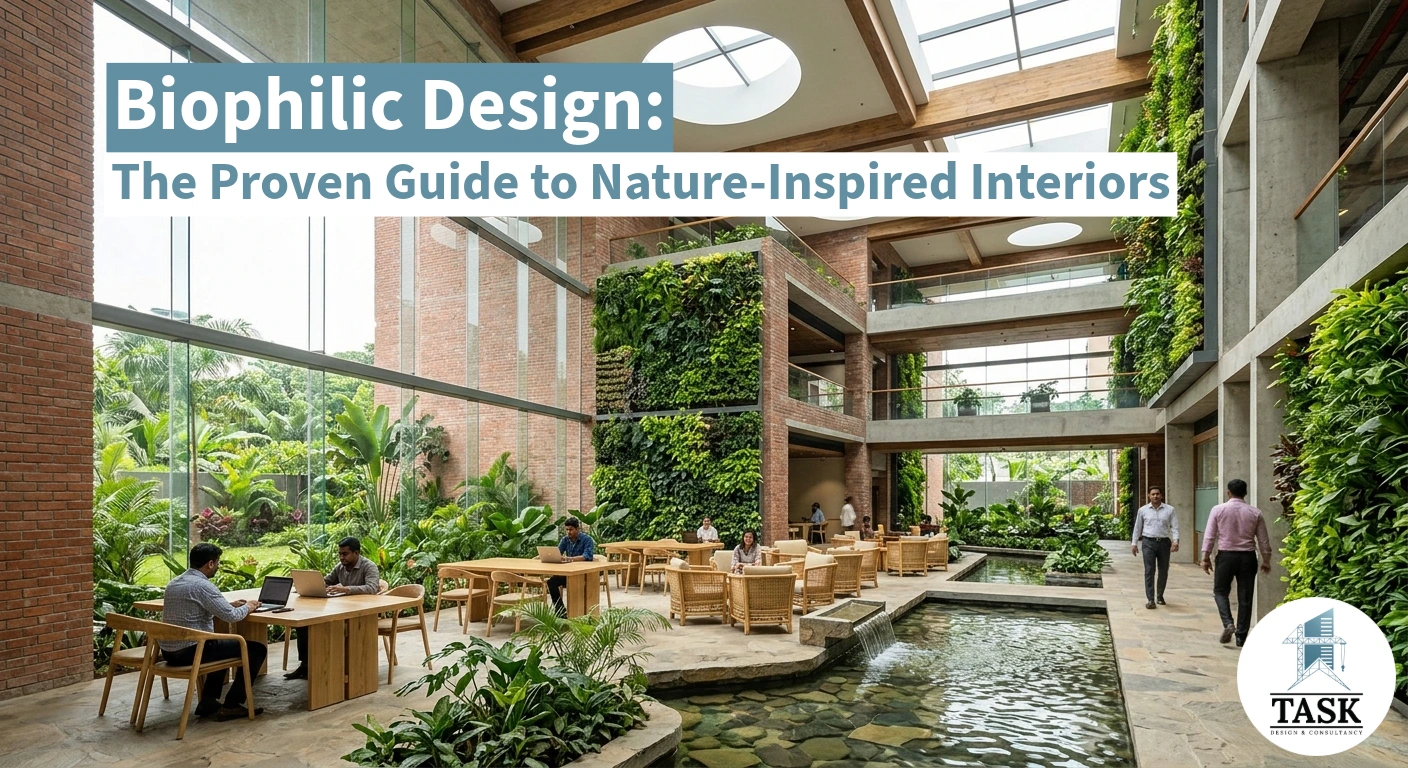
Biophilic Design: 10 Proven Principles for Nature-Inspired Interiors
Biophilic Design: The Proven Guide to Nature-Inspired Interiors
Biophilic design is one of the most research-backed and urgently relevant approaches in architecture and interior design today — and nowhere is that more true than in Dhaka. According to a 2023 study by the Bangladesh Institute of Planners, Dhaka’s green space has shrunk to just 7% of the city’s total area, far below the internationally recommended 15%. Wetlands now cover only 2.9% of the city. The World Bank reported in 2024 that Bangladesh suffered $1.78 billion in economic losses due to rising heat, with Dhaka’s temperature increasing 65% faster than the national average.
For residents of Dhaka, the built interior environment is not supplementing nature — it is replacing it entirely. Biophilic design is the architectural response to exactly this problem. Not as decoration. Not as a trend. As a structural design discipline that addresses what urban density takes away
What Is Biophilic Design?
Biophilic design is the practice of incorporating natural elements, processes, and patterns into built environments. The term comes from “biophilia” — a word coined by biologist E.O. Wilson to describe the innate human affinity for nature that evolved over hundreds of thousands of years.
The argument is straightforward: humans did not evolve in offices, apartments, or concrete cities. We evolved surrounded by vegetation, natural light, moving water, organic textures, and open sky. When those stimuli are removed entirely — as they are for most urban dwellers in Dhaka for the majority of their waking hours — physical and psychological health suffers in measurable, well-documented ways.
Biophilic design brings those stimuli back. Not superficially, and not as an afterthought — as a core design principle applied from the beginning of every project.
Why Biophilic Design Matters More in Dhaka Than Almost Anywhere
Most cities adopting biophilic design principles do so from a position of relative environmental comfort — parks, tree-lined streets, accessible waterfronts. Dhaka does not have that baseline.
With green space at 7% and wetlands at 2.9%, Dhaka’s residents spend the overwhelming majority of their time inside built environments with little or no contact with nature. Rising temperatures are exacerbating respiratory illnesses, fatigue, and mental stress across the city. The economic damage from heat alone — $1.78 billion annually according to the World Bank — is a measure of what inadequate environmental design costs at scale.
This reframes biophilic design from a lifestyle preference into something closer to a public health necessity. When the city cannot provide nature, the building has to.
Visit: Barakah Condominum, a thoughtfully planned residential complex situated within the rapidly growing Priyanka Runway City township in Uttara, Dhaka.
The Science Is Substantial
The research base supporting biophilic design has grown to the point where dismissing it requires ignoring a significant body of evidence.
A study at the University of Michigan found that brief exposure to natural settings improves short-term memory and attention by up to 20%. Research published in the Journal of Environmental Psychology found that workers in offices with natural elements reported 15% higher wellbeing and 6% higher productivity than those in spaces without them. Studies in healthcare settings consistently show that patients with views of nature recover faster, require less pain medication, and experience lower anxiety throughout treatment.
For commercial clients in Dhaka, the implications are direct. Office spaces with biophilic design elements show measurably higher employee retention, lower absenteeism, and stronger satisfaction scores. Restaurants and retail spaces with living plant walls, natural materials, and natural light consistently outperform comparable spaces relying entirely on artificial environment creation — in dwell time, return visits, and brand perception.
The investment in biophilic design is not aesthetic generosity. It pays back.
The Three Core Experiences of Biophilic Design
Stephen Kellert, the architect and academic who did the most to systematize biophilic design as a discipline, organized it into three categories of experience. Understanding these prevents the most common mistake — treating biophilic design as decoration rather than design.
Direct Experience of Nature
Actual, physical contact with natural elements inside a space:
- Natural light entering through windows, skylights, and light wells rather than relying entirely on artificial sources
- Vegetation — indoor plants, living walls, planted courtyards, rooftop gardens
- Water features such as interior fountains, reflection pools, or the ambient sound of moving water
- Natural air movement through cross-ventilation rather than sealed mechanical recirculation
- Natural scents from plants and organic materials rather than synthetic alternatives
In a typical Dhaka apartment, direct nature experience is most practically achieved through plants, natural light maximization, and deliberate ventilation design. Even in a mid-floor unit in a high-density building, a planted balcony, a green wall in the living area, and maximized window exposure make a measurable difference to how the space functions and feels.
Indirect Experience of Nature
Representations and analogues of nature rather than nature itself:
- Natural materials — solid wood, stone, bamboo, clay, rattan — used for floors, walls, ceilings, and furniture
- Nature-inspired patterns drawn from biomimicry: fractal geometries, organic curves, leaf and branch-inspired structural forms
- Natural colors — earth tones, greens, blues, and warm neutrals
- Artwork and visual references to natural landscapes
Indirect experience matters because it works even when direct contact with nature is architecturally limited. A room finished in warm timber, natural stone, and earth-toned textiles feels fundamentally different from one finished in synthetic laminates and painted concrete — even with identical dimensions and window exposure. The material environment shapes mood and cognition whether or not we are consciously aware of it.
Experience of Space and Place
The most subtle category, and the one that most separates serious biophilic design from superficial application:
- Prospect and refuge: open views balanced with sheltered, enclosed spaces — mimicking the experience of sitting at the edge of a forest looking out over open ground
- Mystery and complexity: spaces with depth, layering, and partial concealment that invite exploration
- Dynamic and diffuse light: light that changes quality and direction throughout the day rather than remaining artificially constant
- Variation in ceiling height and spatial scale between rooms that creates movement and interest
For residential projects in Dhaka, this translates most practically into floor plan organization. Open living areas connecting to planted balconies, with smaller intimate spaces branching off them, naturally create the prospect-refuge dynamic. Ceiling heights that vary between rooms create spatial interest. Stairwells that open to skylights introduce light and movement.
Applying Biophilic Design Room by Room
Living Room
The living room is typically the largest space and the best opportunity for biophilic impact:
- Position seating to face the primary window or balcony — prospect orientation
- Install a green wall on the internal wall opposite the main window — it draws the eye inward and improves air quality simultaneously
- Use timber flooring or large-format natural stone tiles rather than synthetic alternatives
- Choose furniture in natural materials: solid wood, linen, cotton, leather, rattan
- Maximize natural light by replacing heavy curtains with sheer fabric that diffuses rather than blocks light
- Add a water feature where space allows — even a small indoor fountain changes the acoustic quality of a room noticeably
Bedroom
Sleep quality is directly affected by biophilic elements:
- Position the bed to have a view of the outdoors or a planted balcony where possible
- Use natural bedding materials — cotton, linen, bamboo fiber — which regulate temperature better than synthetics in Dhaka’s humid climate
- Keep at least two or three plants in the bedroom: snake plants and peace lilies are effective for air quality and require minimal maintenance
- Use natural wood for furniture and avoid high-gloss synthetic finishes
- Install blackout capability but allow natural light in the morning to support circadian rhythm alignment
Home Office
With hybrid work now a permanent feature of professional life:
- Position the desk to face a window with an outdoor view — even a small planted balcony is significantly better than a blank wall
- A large plant positioned within the line of sight — a fiddle leaf fig, monstera, or potted palm — reduces cognitive fatigue during extended work sessions
- A small tabletop water feature improves focus through ambient sound masking
- Natural desk surface materials rather than synthetic laminates
Kitchen and Dining
Often the most neglected room for biophilic application:
- Herb gardens on window sills or above kitchen counters — functional, fragrant, and visually alive
- Natural stone or solid wood countertops rather than synthetic alternatives
- Open shelving in natural wood rather than closed laminate cabinetry — creates visual depth and warmth
- Dining area positioned near the best natural light source in the home
Biophilic Design Using Local Bangladeshi Materials
Biophilic design should not be imported wholesale from other design traditions. It should reflect the materials, climate, and culture of where it is applied. Bangladesh has a rich material culture that maps directly onto biophilic design principles.
Bamboo — locally abundant, structurally versatile, and climatically appropriate. Used for wall panels, ceiling treatments, furniture frames, and decorative screens, bamboo brings natural texture and regional authenticity to any interior.
Clay and terracotta — traditional Bangladeshi building materials with excellent thermal properties in humid climates. Clay tiles, terracotta wall panels, and earthenware accents connect a space to local material culture while performing well in high humidity.
Jute and natural fiber textiles — Bangladesh produces a significant proportion of the world’s jute. Jute rugs, wall hangings, and upholstery fabric are culturally rooted, locally sourced biophilic applications available at every price point.
Rooftop gardens — in Dhaka’s dense residential fabric, the rooftop is often the only available outdoor space. A properly designed rooftop garden — with shade structures, raised planting beds, and seating — transforms unused concrete into a genuinely restorative environment that also reduces the building’s heat load.
Courtyards — traditional Bangladeshi residential architecture organized domestic space around courtyards. Reintroducing the courtyard principle — even in reduced form — into contemporary residential design is one of the most effective biophilic interventions available, particularly in larger homes and commercial buildings.
Common Mistakes to Avoid
Biophilic design is frequently misapplied. The most common errors:
Treating it as decoration. Placing a few plants in an otherwise sealed, artificially lit, synthetic-material space does not constitute biophilic design. The approach needs to be embedded in material selection, light strategy, and spatial organization — not added at the end as styling.
Ignoring maintenance reality. Living walls and indoor plant installations require consistent care. An unmaintained green wall with dying plants produces the opposite of the intended effect. Design the maintenance requirement into the system from the start — automated irrigation, appropriate plant species for available light conditions, and a clear maintenance schedule.
Choosing plants for appearance rather than performance. Snake plants, peace lilies, spider plants, and Boston ferns are among the best performers for air quality in Dhaka’s indoor conditions. Design plant selection around actual light levels, humidity, and air movement — not just aesthetics.
Underestimating natural light. In Dhaka’s residential architecture, windows are often positioned for privacy rather than light. Where renovation allows, maximizing window area and introducing skylights or light wells pays dividends across every other aspect of interior quality.
Biophilic Design and Sustainable Architecture
Biophilic design and sustainable architecture share a consistent direction — both reduce environmental impact while improving human experience, and the two approaches reinforce each other naturally.
Buildings designed with natural ventilation strategies require less mechanical cooling. Buildings with rooftop gardens have lower urban heat island contributions. Buildings using local natural materials carry lower embodied carbon than those using imported synthetic alternatives. Buildings designed to maximize natural light use significantly less electricity.
For homes and commercial spaces in Dhaka, where energy costs are a real daily concern and the urban heat environment is intensifying year on year, the overlap between biophilic and sustainable design is immediately practical — not theoretical.
What Biophilic Design Delivers
| Benefit | Impact |
|---|---|
| Mental health | Reduces anxiety and stress, improves mood and emotional resilience |
| Physical health | Improves air quality, sleep quality, and circadian rhythm alignment |
| Productivity | Increases focus, creativity, and sustained concentration |
| Energy efficiency | Reduces cooling and lighting loads through passive strategies |
| Material durability | Local natural materials perform better in Dhaka’s climate long-term |
| Community connection | Builds stronger emotional attachment to spaces and places |
Biophilic Design in Dhaka: Task Design & Consultancy’s Approach
At Task Design & Consultancy, biophilic design principles are integrated into residential and commercial interior projects in Dhaka as structural design decisions — not decorative additions. The firm’s approach consistently incorporates natural material selection, light maximization strategies, ventilation planning, and indoor-outdoor connection where the architecture allows.
The BUET-trained architects and designers at Task DNC understand Dhaka’s specific environmental conditions — the humidity, the heat, the density, the limited green space — and design around them from the earliest stage of every project. If you are planning a home or commercial interior and want a team that takes the relationship between space and human wellbeing seriously, get in touch at contact@taskdnc.com or visit taskdnc.com.


