

Traditional Bengali Architecture: 7 Brilliant Secrets for Modern Homes
Traditional Bengali Architecture: 7 Brilliant Secrets Still Transforming Modern Homes
Traditional Bengali architecture is one of the most climatically intelligent and culturally rich design traditions in South Asia
— and it is being rediscovered. In a design landscape flooded with imported aesthetics that perform poorly in Bangladesh’s tropical climate and sit uneasily against its cultural identity, the principles of traditional Bengali architecture offer something more valuable than novelty: a proven system of design built specifically for this place, refined over centuries of direct feedback from the environment.
This post breaks down the seven most powerful principles from traditional Bengali architecture and shows how each one is being reinterpreted in contemporary home design in Bangladesh today
What Made Traditional Bengali Architecture So Intelligent
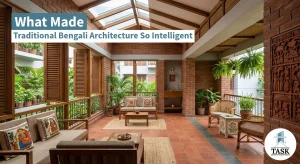
Before getting into how these principles are being applied today, it is worth understanding why they worked so well in the first place — because the reasons are not sentimental. They are practical. Traditional Bengali architecture — from the rural homesteads of the delta to the zamindari mansions of the 18th and 19th centuries — was shaped by a specific set of constraints: intense heat, high humidity, heavy monsoon rainfall, and limited access to imported materials. The design solutions that emerged from these constraints were not decorative choices. They were functional ones, refined over generations of direct feedback from the environment.
Thick mud and brick walls that absorbed heat during the day and released it slowly at night. Sloped tiled roofs that shed monsoon rain efficiently and created ventilated roof spaces. Tall ceilings and louvered windows that allowed hot air to rise and escape. Central courtyards that created natural ventilation corridors and cooled microclimates within the building’s footprint. Shaded verandas that blocked direct sun while maintaining connection to the outdoors.
Every one of these solutions addresses a problem that home interior design Bangladesh still faces today. The climate has not changed. What has changed is that much of the modern construction in Dhaka ignores these solutions in favor of sealed, air-conditioned boxes that consume enormous amounts of energy to achieve a level of comfort that traditional design achieved passively.
The revival of Bengali architectural principles in contemporary design is not a cultural exercise. It is an engineering correction.
1. The Uthan — Reimagining the Courtyard for Modern Homes
The uthan — the central courtyard — was the organizing principle of traditional Bengali domestic life. It was simultaneously the home’s ventilation system, its social center, its spiritual space, and its primary source of natural light for the surrounding rooms.
In architectural terms, it worked because it created a thermal chimney effect: air heated by the sun in the open courtyard rose and drew cooler air through the surrounding rooms, creating passive cross-ventilation without any mechanical assistance.
In contemporary home interior design Bangladesh, the uthan is being reinterpreted in several forms that preserve this functional logic while adapting to modern spatial constraints:
Indoor atriums that bring natural light and ventilation into the center of larger homes and apartment buildings. Rooftop gardens that serve the social and restorative function of the traditional courtyard while adding insulation to the roof and reducing the urban heat island contribution of the building. Sunken lounges with skylights that create the enclosed-yet-open spatial quality of the courtyard in a compact urban footprint. Light wells in mid-rise apartment buildings that allow natural light and air movement to penetrate floors that would otherwise be entirely dependent on artificial systems.
The courtyard principle is one of the most valuable contributions traditional Bengali architecture makes to contemporary sustainable design — and one of the most underused in Dhaka’s current residential construction.
2. Climate-Responsive Design — Then and Now
Climate-responsive design is not a new concept in Bangladesh. It is, in fact, the foundation on which all traditional Bengali architecture was built — and its abandonment in modern construction is one of the primary reasons why energy consumption in Dhaka’s residential sector is so high.
Traditional Bengali homes handled climate through passive means:
Thick walls in mud or brick that acted as thermal mass — absorbing heat during the day and releasing it slowly after sunset, keeping interiors cooler during peak heat hours. Cross-ventilation achieved through the strategic placement of openings on opposite sides of rooms, allowing prevailing breezes to pass through. Large overhangs and deep verandas that shaded walls and windows from direct sun, dramatically reducing solar heat gain. Sloped roofs with ventilated roof spaces that prevented solar heat from radiating directly into the living spaces below.
Contemporary home interior design Bangladesh inspired by these principles translates them into modern materials and construction methods:
Compressed earth blocks and laterite stone used for walls with high thermal mass. Clay tiles and terracotta used for roofing and cladding that perform better in heat and humidity than metal or concrete alternatives. Central courtyard and light well design that creates natural ventilation corridors through the building. Deep overhangs and horizontal sunshades incorporated into the architectural form rather than added as afterthoughts.
Each of these approaches reduces dependence on mechanical cooling — which in Dhaka’s electricity environment is a direct financial benefit as well as an environmental one. A home designed with climate intelligence built in from the start costs substantially less to live in over its lifetime than one that relies entirely on air conditioning to be habitable.
3. The Veranda — From Social Architecture to Interior-Outdoor Living
The veranda — or dalan — was one of the most socially important spaces in traditional Bengali domestic architecture. It was the transition zone between public and private life: the place where the family received guests, where children played, where women worked in the shade of the afternoon, where conversations happened that were too informal for the interior rooms and too intimate for the street.
Architecturally it was also the building’s first line of climate defense — shading the walls and windows behind it from direct sun, providing shelter from monsoon rain while maintaining connection to the outdoor environment, and creating a buffer zone of cooler, shaded air between the harsh outdoor conditions and the interior living spaces.
In contemporary home interior design Bangladesh, the veranda is being reinterpreted with the same functional intelligence:
Semi-open dining areas that connect to planted outdoor spaces, extending the living area while maintaining protection from rain and direct sun. Indoor-outdoor transition zones with sliding or folding screens that allow the boundary between inside and outside to be adjusted according to weather and use. Reading corners and sitting areas with cane or rattan furniture, ceiling fans, and hanging greenery that recreate the unhurried, shaded quality of the traditional veranda. Covered terraces in apartment buildings that serve the social and climatic functions of the veranda within a multi-storey context.
The veranda’s logic — shade, shelter, social connection, climate buffering — is as valid in a contemporary Dhaka apartment as it was in a 19th century zamindari estate. The form changes. The function is identical.
4. Terracotta, Timber, and Local Materials — The Case for Building With What’s Here
Traditional Bengali architecture used locally available materials not because imported alternatives were unavailable but because local materials performed better in local conditions. Mud and brick absorbed and released heat at rates suited to the climate. Bamboo was structurally versatile, fast-growing, and easy to work. Terracotta was durable in humidity. Wood from local species was resistant to the insects and moisture that would destroy less adapted alternatives.
This is not merely historical observation. It is a principle that contemporary home interior design Bangladesh is increasingly returning to, both for environmental reasons and because the aesthetic results are significantly more compelling than interiors built entirely from imported synthetic materials.
Terracotta tiles used for flooring and wall cladding bring warmth, texture, and excellent thermal performance — they stay cool underfoot even in summer and develop a richer appearance over time rather than deteriorating. Hand-carved wooden panels and screens — jali work — used for room dividers, decorative walls, and window screens offer privacy and ventilation simultaneously, with a visual depth that no manufactured alternative achieves. Exposed brickwork that celebrates the material honesty of the structure rather than hiding it behind plaster and paint. Antique doors and architectural salvage reused as statement pieces — a carved doorway from a demolished zamindari house installed as the entrance to a contemporary living room creates a connection to history that no new object can replicate.
At Task Design & Consultancy, local and traditional materials are incorporated into residential interior projects in Dhaka wherever the design allows — not as decoration but as structurally and climatically appropriate choices that also produce more distinctive and culturally resonant spaces.
5. Craftsmanship and Artisanal Expression — The Details That Make a Home
Bengali architecture has always been inseparable from its artisanal traditions. The terracotta temples of Bishnupur, with their intricate panels depicting scenes from the Mahabharata and Ramayana. The scroll paintings of the Patua tradition. The carved wooden facades of traditional homesteads. The wrought-iron railings of colonial-era Calcutta and Dhaka. The hand-painted nakshi kantha textiles used as wall hangings and bedcovers.
These traditions represent accumulated craft knowledge of extraordinary depth — and they are at serious risk of disappearing as industrial production makes handmade goods economically marginal.
Contemporary home interior design Bangladesh has an opportunity to address both a design problem and a cultural preservation problem simultaneously. Integrating authentic artisanal work into modern interiors produces results that mass production cannot replicate — and sustains the communities and traditions that produce them.
Terracotta relief panels used as feature walls or exterior cladding. Hand-carved wooden doors and screens that function as the interior’s primary decorative statement. Nakshi kantha textiles used as wall hangings, cushion covers, and bedding that bring pattern, warmth, and cultural narrative into a contemporary interior. Brassware and hand-thrown pottery used as lighting fixtures and decorative objects. Murals inspired by Bengali folk traditions — Patua scroll painting, Jamdani textile patterns — applied to feature walls in living areas and stairwells.
Each of these choices produces a home that tells a story specific to this place and this culture — something that an interior assembled from generic international suppliers, however expensive, fundamentally cannot do.
6. Community and Multi-Generational Spatial Design
Traditional Bengali architecture was designed for multi-generational living and communal social life. The spatial organization of the traditional homestead — multiple sleeping rooms arranged around a shared courtyard, common spaces generous enough for large family gatherings, separate areas for different generations without sacrificing connection — reflected a social structure in which the extended family was the primary unit of life.
Contemporary living patterns in Dhaka are more varied, but the underlying social needs have not disappeared. Multi-generational households remain common. Hospitality is culturally central. The desire for both privacy and connection — spaces where family members can be together and spaces where they can be alone — is universal.
Contemporary home interior design Bangladesh inspired by traditional Bengali spatial logic addresses these needs through:
Flexible room layouts with moveable partitions that allow spaces to expand for family gatherings and contract for private use. Open-plan living, dining, and kitchen arrangements that echo the communal spirit of the traditional courtyard without sacrificing the functional organization of the modern home. Dedicated spaces for prayer, meditation, or quiet retreat — a modern interpretation of the thakur ghor — that acknowledges the spiritual dimension of Bengali domestic life. Guest accommodation that is genuinely welcoming rather than a converted storage room, reflecting the Bengali cultural emphasis on hospitality.
These spatial choices produce homes that feel inhabited and alive in a way that rigidly partitioned, single-use rooms rarely do.
7. Nature Integration — Bengali Reverence for the Living Environment
Nature was not an amenity in traditional Bengali architecture. It was a participant. Tulsi plants tended daily in the central courtyard. Lotus ponds and fish tanks providing food, beauty, and cooling. Mango and jackfruit trees defining the seasonal rhythm of domestic life. The monsoon itself — rather than being feared and excluded — accommodated and celebrated in the architecture’s drainage design, roof forms, and open spaces.
This relationship with nature is one of the most transferable aspects of traditional Bengali architecture to contemporary home design — particularly in the context of Dhaka’s severely degraded urban natural environment. As confirmed by the Bangladesh Institute of Planners, Dhaka’s green space stands at just 7% of the city’s area, far below the internationally recommended 15%.
For most apartment dwellers, the built interior is the primary environment. Bringing nature into that environment is not a decorative choice. It is a genuine quality-of-life intervention.
Rooftop gardens that recreate the productive, restorative quality of the traditional homestead garden in an urban multi-storey context. Planted balconies and green walls that introduce vegetation into apartments where ground-level outdoor space is unavailable. Indoor water features — even modest ones — that bring the acoustic and cooling quality of the traditional pond into a contemporary interior. Natural materials throughout the home that maintain a sensory connection to organic textures even in a fully urban environment.
The Bengali reverence for nature was not sentimental. It was practical — born from living closely enough to the natural environment to understand what it gave back. Contemporary home design in Bangladesh benefits from recovering that understanding.
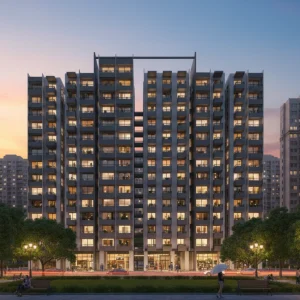
Visit: Barakah Condominium, a thoughtfully planned residential complex situated within the rapidly growing Priyanka Runway City township in Uttara, Dhaka.
Why This Matters Beyond Aesthetics
The revival of traditional Bengali architectural principles in contemporary design is not a nostalgic exercise and it is not simply an aesthetic preference. It is a response to several overlapping practical problems that generic modern construction in Dhaka consistently fails to solve.
Climate performance: traditional Bengali design principles produce buildings that are genuinely more comfortable in Dhaka’s specific climate without the energy cost of mechanical systems. Cultural identity: homes designed with Bengali architectural vocabulary belong to their place in a way that generic international design does not. Sustainability: local materials, passive climate strategies, and nature integration all reduce environmental impact. Wellbeing: the spatial generosity, natural materials, and connection to nature that characterize traditional Bengali architecture produce living environments that are measurably better for their inhabitants’ physical and mental health.
These are not small benefits. They are the difference between a home that works and a home that merely stands.
Task Design & Consultancy’s Approach
Task Design & Consultancy‘s approach to home interior design Bangladesh integrates traditional Bengali architectural principles where they serve the client’s specific space, climate conditions, and cultural identity. The firm’s BUET-trained design team understands both the historical depth of Bengali architectural tradition and the practical requirements of contemporary residential and commercial projects in Dhaka.
Whether the project is a full residential interior, a renovation that incorporates traditional elements into an existing space, or a new build designed from the ground up with Bengali climate intelligence built in, the team approaches each project with the specific conditions of the site and the specific needs of the client in mind.
Get in touch at contact@taskdnc.com or visit taskdnc.com to speak with the team about your project.


